


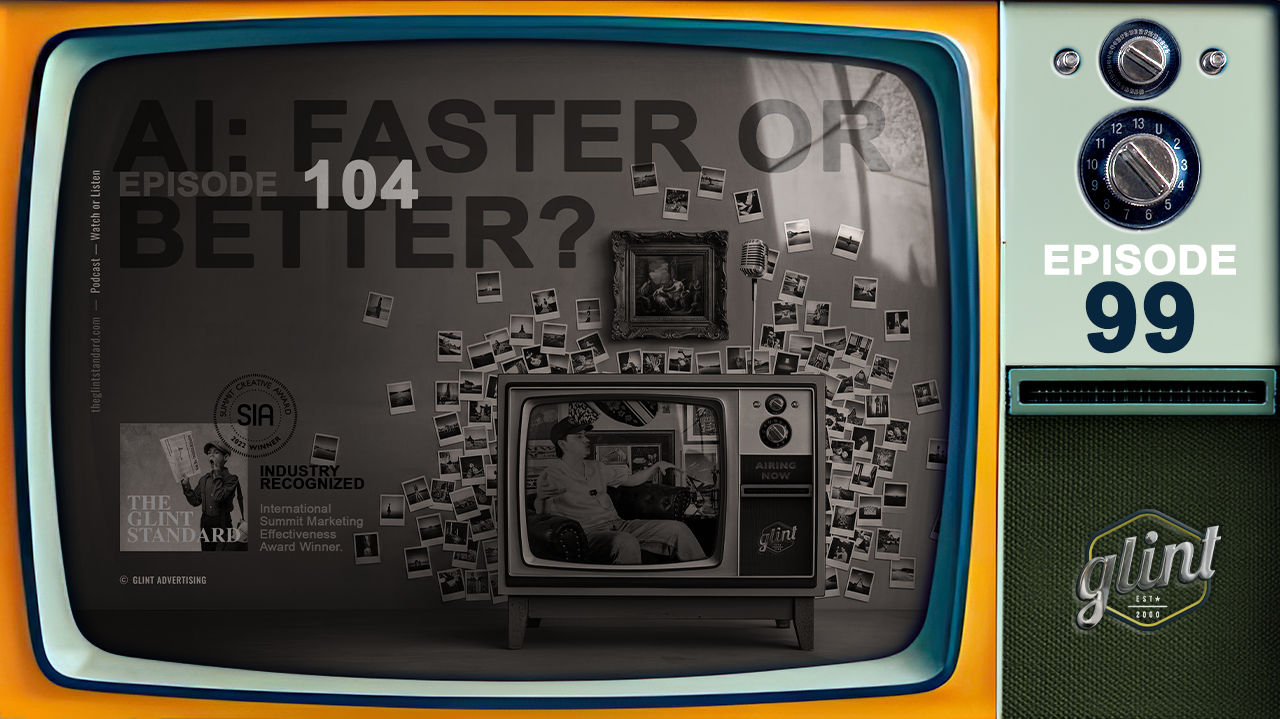
Episode 104 | AI: Faster or Better?
Artificial intelligence has removed much of the friction from marketing. An image that once required a photoshoot can be generated in seconds. AI can draft an email almost instantly. Automations that once took hours to set up can now be built with a few instructions. There is no question that AI has made us faster. The more interesting question is whether all that speed is actually improving the work. That distinction matters because access to AI is quickly becoming universal. If every business can create more content, generate more images, and automate more processes, increased production alone isn’t much of a competitive advantage. In some cases, it may even create the opposite. We’re beginning to see more marketing that looks polished at first glance but increasingly feels like everything else.
Stop Selling and Start Learning
When convenience creates sameness.
We’ve seen this transition before. Before stock photography became commonplace, businesses invested in original photography because they needed imagery specific to their products, people, and stories. Stock photography made professional imagery faster and more affordable, but eventually the same photographs started appearing everywhere.
AI is taking that accessibility much further. Instead of searching for a stock photograph of a burger, you can simply ask AI to create one. The problem comes when the generated burger looks nothing like the one your restaurant actually serves. The technology isn’t necessarily the problem; the starting point is. Rather than asking AI to invent your brand, begin with something that’s actually yours. Use your photography, environment, products, people, visual style and ideas as the foundation. Then use AI to manipulate, expand or explore those assets. The technology becomes part of the creative process instead of replacing it.
Give AI a job, not the company.
One of the simplest ways we’ve found to think about AI is to treat it like a talented intern or apprentice. An intern can accomplish a tremendous amount of work, but you wouldn’t give someone their first assignment and immediately publish whatever comes back. You provide direction. You review the work. You identify what isn’t right. You provide more context and continue refining until the result meets the standard. AI requires the same management.
The temptation is to assume that because something can be produced in seconds, the process should now take seconds. That’s where faster begins working against better. The first output isn’t necessarily the finished product. It is often the beginning of the work.
AI doesn’t eliminate the work. It moves it.
There is another assumption worth challenging: AI is supposed to save us time. In our experience, it often changes where we spend that time. Instead of spending hours manually executing tasks, AI may handle much of the initial production. That creates an opportunity to spend more time thinking about strategy, refining the idea, protecting the brand, and considering how the audience will respond. That’s a much more valuable use of the technology than simply filling the calendar with twice as much content.
The businesses that benefit most from AI may not be the ones that use it to do less work. They may be the ones that use it to do more of the work that actually requires human judgment.
Your audience still gets a vote.
There is no universal answer for how visible AI should be in marketing because audiences don’t respond to it the same way. Some people are fascinated by AI and comfortable consuming AI-generated content. Others immediately distrust something when it looks or sounds artificial. That makes AI adoption as much a customer decision as a technology decision. Before deciding how aggressively to incorporate AI into your marketing, understand the people on the other side of the message. If obvious AI creates distance between your brand and your audience, efficiency isn’t helping you. Marketing still has to feel like communication between people.
AI will continue to get faster, more capable, and harder to distinguish from traditionally produced work. That makes human judgment more important, not less. The opportunity isn’t simply learning how to use AI. It’s learning where to use it, how to manage it and when the better decision is to slow down.
Watch or listen to Episode 104 of The Glint Standard, “AI Makes You Faster. It Doesn’t Make You Better,” for our full conversation about AI, creativity, authenticity and what businesses should keep human.
Frequently asked questions
- Does AI make marketing better? AI can make marketing faster and expand what a team can produce, but better results still depend on strategy, creativity, brand understanding and human review.
- How should businesses use AI in marketing? Use AI to support execution, automation, exploration and refinement while keeping people responsible for creative direction, accuracy and final decisions.
- How can brands avoid generic AI content? Start with original ideas, photography, products and brand assets, then use AI to extend or manipulate them rather than asking the technology to invent the brand from scratch.
- Should AI replace human creativity in marketing? The episode’s position is no. AI works best when it supports a creative vision rather than determining the vision itself.
- Is AI making marketing better or just faster? Right now, AI’s clearest advantage is speed. Better marketing still depends on the people who direct the technology, refine its output, and decide what deserves to be created.
- How can businesses use AI without losing brand authenticity? Start with original photography, ideas, products, environments, and brand assets whenever possible. AI can then extend the creative direction rather than inventing an identity from a generic prompt.
- Why treat AI like an intern or apprentice? Because AI performs best with direction and oversight. Give it context, review its work, identify mistakes, and refine the output before it represents your business.
- Does AI reduce a marketing team’s workload? Not necessarily. The episode argues that AI often shifts the workload from manual execution toward strategy, editing, creative direction, and brand management.
- Should every audience be marketed to with AI in the same way? No. Audience attitudes toward obvious AI content vary, making customer expectations an important consideration when deciding how visibly AI should appear in marketing.
- Is AI better at marketing than people? AI is particularly effective at accelerating execution, automation and content development. The episode argues that strategy, creative direction, brand judgment and understanding the audience still require meaningful human involvement.
- What does human-in-the-loop mean in marketing? It means people remain responsible for directing, reviewing and refining AI’s work rather than publishing its initial output without oversight.
- Can AI make a brand look generic? Yes. Generic prompts and unedited AI output can create work that feels disconnected from the actual business. Starting with original brand assets and a clear creative direction helps preserve authenticity.
- Does AI really save marketers time? The episode challenges that assumption. AI can reduce execution time, which can then be reinvested in strategy, editing, creative development, and improving the final product.
- How should businesses decide how much AI to use? Consider both the task and the audience. AI can work heavily behind the scenes, while customer-facing uses should reflect the target audience’s comfort with AI-generated experiences and content.
If you enjoyed this conversation, subscribe to The Glint Standard for more discussions with business leaders, marketers, and entrepreneurs exploring the ideas that shape stronger brands, better leadership, and sustainable business growth.
Listen to every audio episode:
Watch every video episode:
Read more insights from Glint:
Learn more about Glint Advertising: